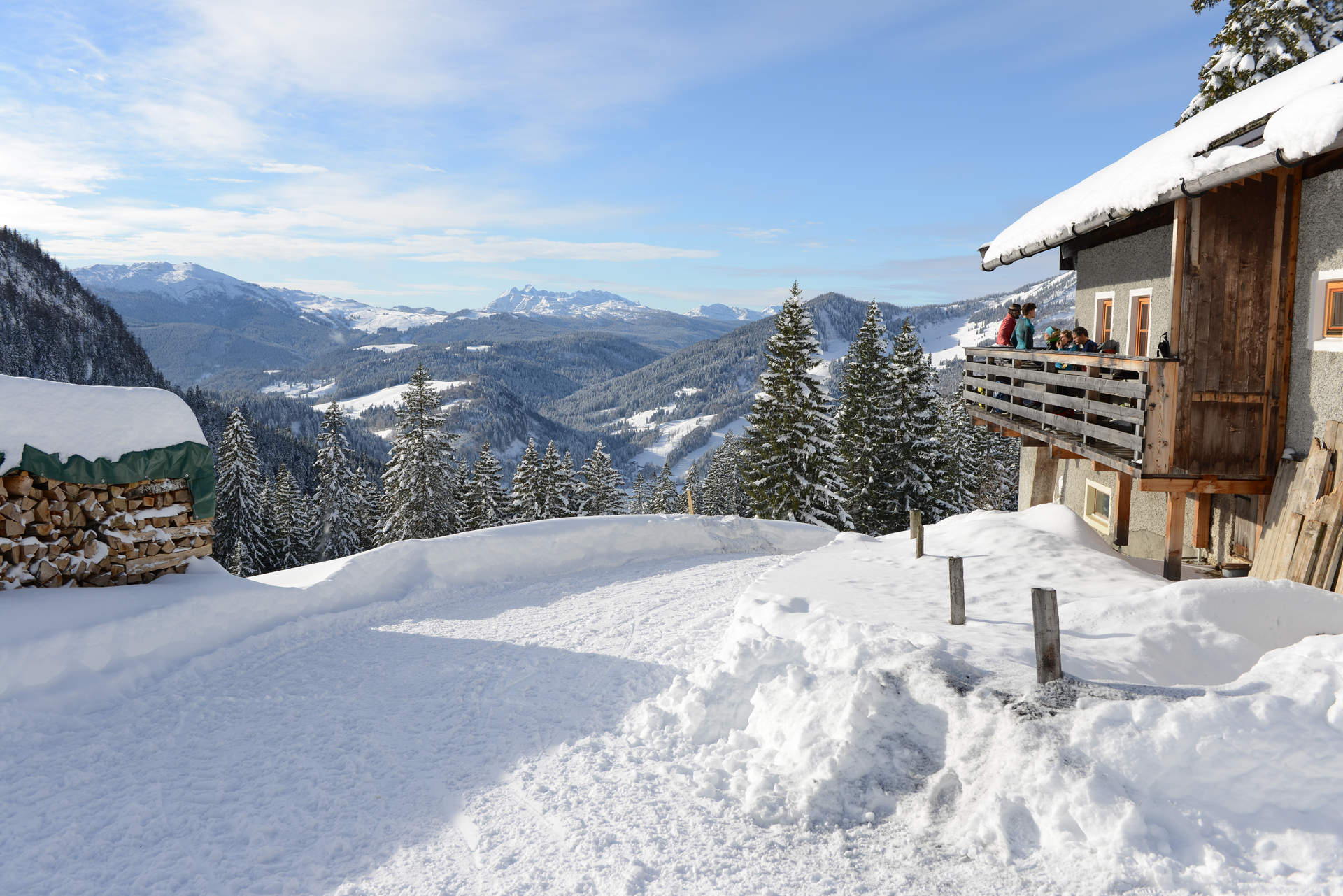
Klaus, the hut owner, talks about the winter activities on the Hochalm in Unken.
Whether you hike up on foot and ride down on a sled , go snowshoeing or go on a ski tour : A stop at the Jausenstation is a must. The cheese dumplings, Kaiserschmarrn, and cheese gnocchi are legendary. The Hochalm is a wonderful place to slow down and reflect on what really matters. After the roughly one-and-a-half-hour climb, sitting in the wood-heated hut with coffee and homemade cake, you can simply forget about the time and your schedule. Life can be enjoyed on the winter alpine pasture—with or without snow. Huts owner Klaus explains that working on the mountain isn’t always easy. He hopes that people will learn once again to be content with less. He took the time to speak with us on a mild August evening.
What is daily life like at the alpine hut in winter?
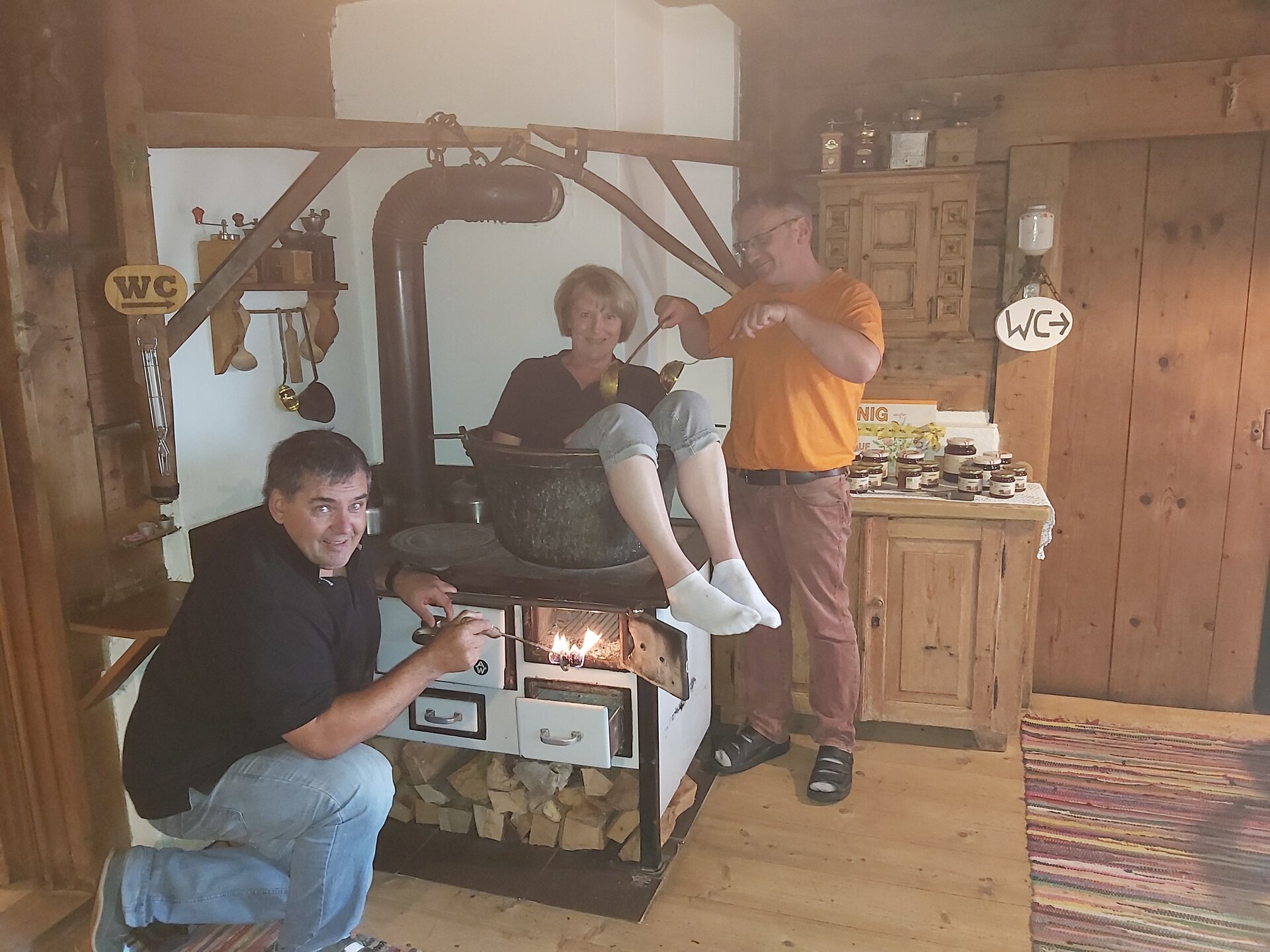
In winter, we’re only at the hut during the day. In the morning, we drive up and turn on the heat. We’ve had electricity since 2017; before that, we managed without it. We really like having electricity now. We heat with wood and cook with gas, but also on the wood-burning stove. We get visitors who are ski tourers, snowshoers, and, of course, sledders. In the evening, we drive back down, and I tidy up the toboggan run a bit. I clear the path up here with the tractor. When there’s a lot of snow, I sometimes need help.
What do you do when there’s no snow? Are you closed then?
No, no. Last Christmas we didn’t have any snow, but the guests were all in a great mood because the weather was fantastic. When the weather is nice, people are still out and about in late fall. As soon as the snow arrives, they come up on sleds and snowshoes. So there’s really never a slow season because people have become so athletic and active. They just love to be out and about. But in the spring and fall, we do get a break now and then.
What are your culinary highlights in the winter?
The menu in the winter is almost the same as in the summer, just a bit more limited. The classics are always a hit: cheese dumplings, Kaiserschmarrn, and cheese gnocchi. Since it’s so busy in winter and there are only the two of us in the kitchen, we can’t offer everything. We do our best, but the work at the alpine pasture is simply more difficult. We’re not a mountain restaurant or a ski lodge. Of course, we accommodate certain needs—for example, we offer vegetarian and vegan dishes—but there are limits. I’ll never serve french fries, and I’ll never have a deep fryer. I run an alpine hut, period.
How long have you and your team been running the snack bar?
I’ve been up here for 40 years; Rudi and Margot for 30 years.
What has changed over that time?
One positive change is that there are a lot of young people out and about these days, including many groups of girls. That wasn’t the case when I first started. The young people are active: biking, climbing, running. People have become more athletic. On the downside, they don’t have time anymore. Everything has to go fast—and even faster. No one has time to wait anymore, or to just relax. Many people are under so much pressure. That’s a shame. Forty years ago, people were much more content. They were happy just to have a lodge where they could be served. Today, everything is taken for granted. There are people who sit down and ask: “What do you have that’s vegan?” “What’s the Wi-Fi password?” It’s different than it used to be. Even when it comes to food, many people don’t understand that when something’s out of stock, it’s simply out of stock. I’d have to drive the snowblower all the way down to the village and switch to my car to go shopping. That’s not so easy.
What is the appeal for you of working as a hut owner on the alpine pasture?
It’s the work itself, interacting with people. It’s not a boring job. Every day, the cards are reshuffled. You never know what’s coming next. That’s the beauty of it. And in the evening, when you can feel satisfied that the day went well, you sit out on the terrace and reflect on the day. Just the other day, a family came to us for breakfast. As they were leaving, the father told me how incredibly grateful he was to us, because his little daughter had been playing with the chickens the whole time. She carried the hens around for an hour and didn’t ask for her cell phone even once. Some people tell me that they love coming back every year and how wonderful it is that we’re still here. They don’t even look at the menu—they already know what they want to order. That’s when I know we’re on the right track.
If you could make one wish while up on the Hochalm, what would it be?
That we stay healthy. And that people learn again what it means to slow down, what contentment is. That you can be happy with very little. That you appreciate being healthy and being able to hike up the mountain. There are many people who would love to do that but can’t. The approximate hiking time is posted down below. Some people come up here and say, “It took us much less time than that.” But that’s not the point—it’s not about looking at my watch and making it in a certain amount of time. I have to walk at a pace that’s good for me, that I enjoy. It’s so lovely when little kids say, “We saw flowers and butterflies; we found strawberries and blueberries.” For me, the best thing is when I can make people happy. That might sound corny, but if I can help ensure our guests have a wonderful day, that’s the greatest fulfillment for me. We’re happiest when people are satisfied.
Do you also notice changes up here on the alpine pasture when it comes to the climate and the environment?
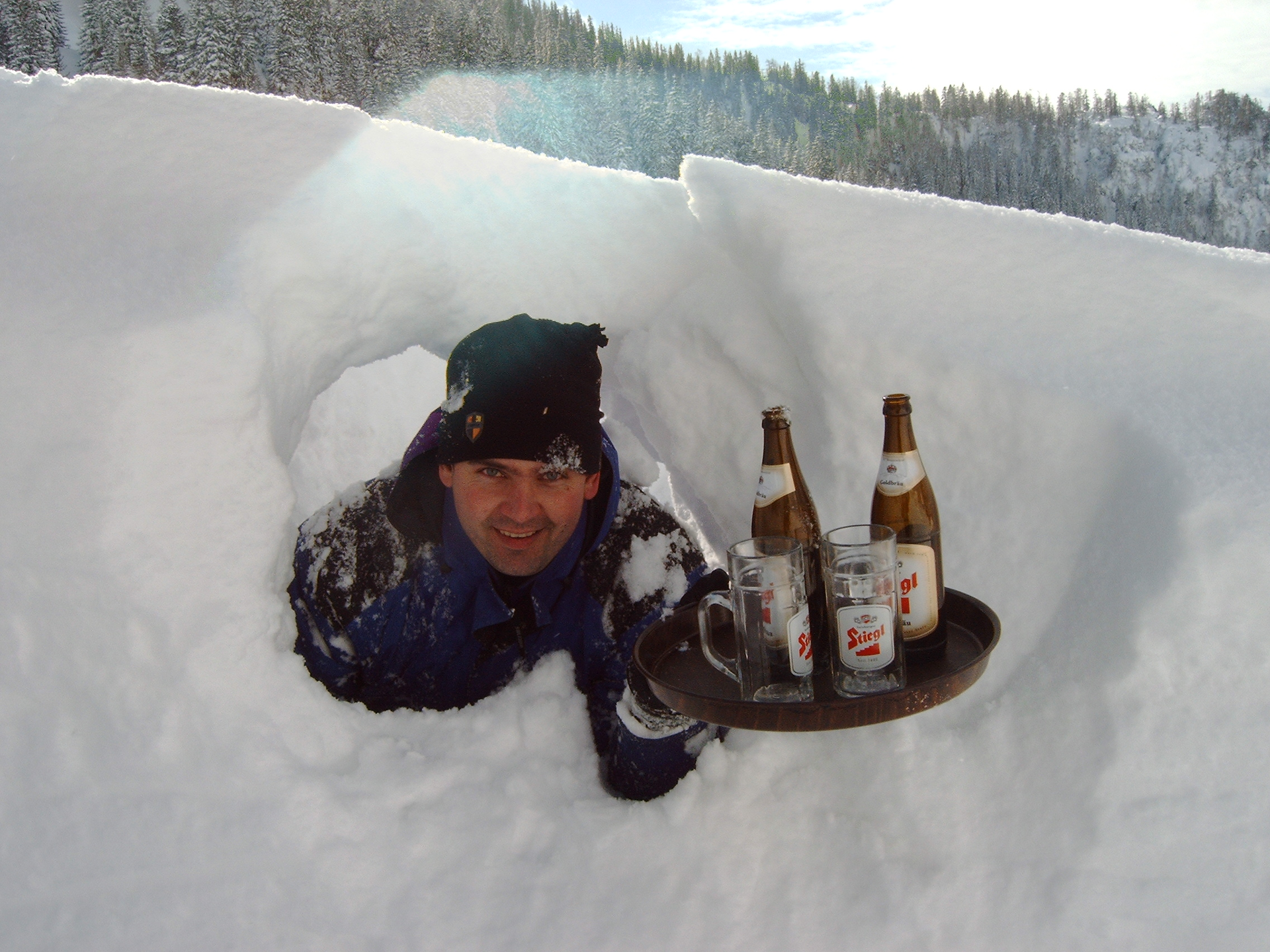
There definitely are changes. In the early years when I was up here, back in the ’80s, nobody ever asked for a parasol in the summer. I didn’t even have a parasol. And now, as soon as the sun comes out, we need a parasol right away—otherwise, it’s unbearable. Winters have gotten shorter and aren’t as cold anymore. When I think about how cold it used to be up here—for weeks and months on end…—we’d be happy in February just to sit in the sun by the hut wall.
What do you do when you’re not at the hut?
In short: I’m at home. Or we go on vacation, sometimes together, because we get along well. We’ve been working together for over 30 years. You have to get along well, especially at a mountain hut. There’s no way around it. You can’t just say, “Get off my back, I’m leaving now.”
What do you do when the atmosphere at the alpine hut gets tense?
We ignore each other (laughs). No, it’s completely normal in the hospitality industry to have the occasional spat. Things aren’t always rosy for us either. We make up again. There’s a little spat and a cleansing storm, and then things get back on track—the sun shines again. We laugh together and make up. It’s almost like a marriage, I’d say.
How did you become the owner of the Hochalm mountain hut?
My grandparents started this snack bar here in 1969. My grandfather was retired and didn’t know what to do at home. He decided to open a snack bar here. The Hochalm is one of the few alpine pastures that has been used for grazing livestock all these years. When my grandparents needed some help one time, I spent a summer up here. That one summer eventually turned into forty. My parents later started the toboggan run in the winter. Back then, I was away for the winter—in Switzerland and Australia. Since 1989, I’ve been up here in the winter, too.
Australia?
That was my dream, one I’d always pursued. Actually, I wanted to go to sea. But no one would take me on board because I didn’t speak English. So I thought to myself, I’ll go somewhere in the winter where English is spoken. That was Australia once and New Zealand once. But the ship left without me (laughs).
What a stroke of luck for the guests at the Hochalm. Thank you very much for the interview, Klaus.